
Published on: July 22, 2026.
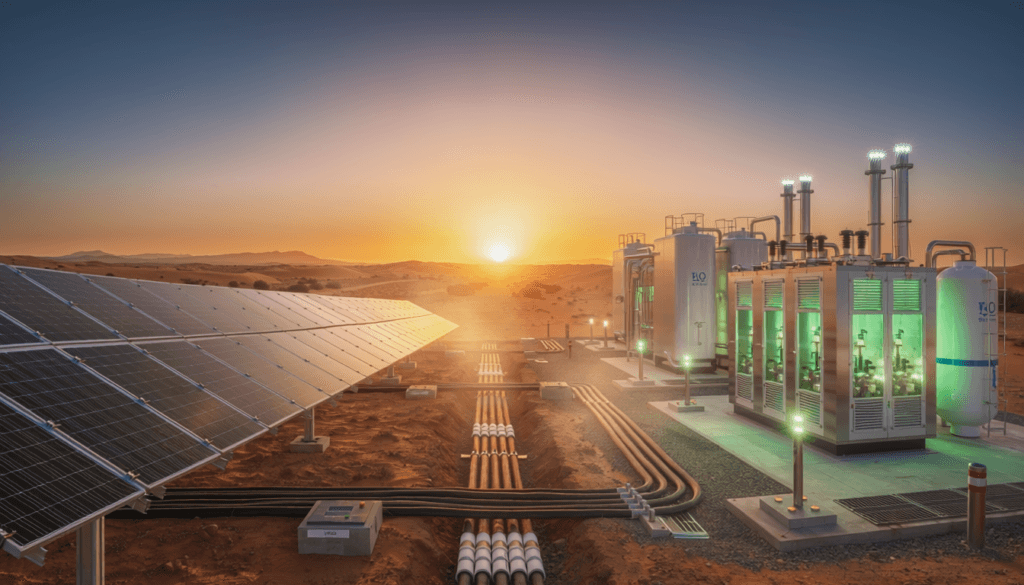
There is a number that should be at the center of every conversation about green hydrogen in MENA and Africa right now.
It is not the billions of dollars announced. It is not the gigawatts of electrolyzer capacity planned. It is not the export targets set by governments from Morocco to Namibia.
The number is this: only one out of 31 green hydrogen projects in Africa has reached a final investment decision.
One. Out of thirty-one.
83% of MEA hydrogen capacity remains held in the feasibility stage. The slower-than-anticipated development of African mega-projects has been the primary driver, as developers reassess timelines amid rising borrowing costs and elevated risk premiums.
Everyone is looking for the reasons in the right places — lack of offtake agreements, high infrastructure costs, regulatory uncertainty, weak demand signals from European buyers. These are real obstacles and they deserve serious attention.
But there is one reason that is almost never discussed — and that sits at the foundation of every green hydrogen project’s financial model.
The performance of the solar PV plants that are supposed to power these electrolyzers.
Disclosure: This article contains affiliate links. If you purchase through these links, I may earn a small commission at no extra cost to you. I only recommend technical resources that I consider genuinely useful for industrial solar professionals working in Africa and the MENA region.
The Scale of the Ambition — And the Scale of the Reality Gap
The ambition is genuine and the resources behind it are significant.
Africa could produce up to 50 million tons of low-carbon hydrogen annually by 2035. South Africa is advancing several flagship initiatives, including the Coega Green Ammonia Project near Nelson Mandela Bay, which plans to deploy a 1.2 GW electrolyzer powered by 3.5 GW of renewable energy from solar and wind — backed by 20 million USD from the SA-H2 Fund, with financial close targeted for late 2026 and commercial operations expected around 2029.
Mauritania targets 12.5 million tons of hydrogen by 2035 — hosting some of sub-Saharan Africa’s largest green hydrogen projects, including CWP Global’s 30 GW Project AMAN, TotalEnergies and Chariot’s 10 GW Project Nour, and GreenGo Energy’s 60 GW Megaton Moon.
In Morocco, the picture is equally ambitious — and equally delayed. The Guelmim Green Hydrogen project was supposed to come online in 2026 but was not under construction as of October 2025. Only one of fourteen projects slated to come online by 2028 across Africa is currently under construction.
DNV expects the industry to expand more slowly than previously forecast, cutting its long-term outlook for clean hydrogen by 45% compared with its 2022 forecast, as projects have been delayed and policy support has weakened.
The gap between announced ambition and actual execution is not marginal. It is structural. And one of its structural causes is hiding in plain sight — in the feasibility studies that model the solar PV performance those electrolyzers depend on.
The Solar PV Problem at the Heart of Green Hydrogen Economics
Green hydrogen is produced through electrolysis — splitting water into hydrogen and oxygen using electrical current. The economics of this process are straightforward: the cheaper and more consistent the electricity input, the more competitive the hydrogen output.
Abundant sunshine and desert winds give the Middle East and North Africa some of the world’s best conditions for producing green hydrogen, raising hopes the region could become a global powerhouse for a fuel seen as vital to the energy transition.
This is true. Morocco, Mauritania, Namibia, and the Gulf states have exceptional solar resources. But exceptional solar resources and exceptional solar plant performance are not the same thing.
The Levelized Cost of Hydrogen — the metric that determines whether a green hydrogen project is bankable — depends directly on three variables: the capital cost of the electrolyzer, the efficiency of the electrolysis process, and the cost and consistency of the renewable electricity input.
That third variable is where the problem lives.
If the solar PV plant feeding an electrolyzer performs at a sustained Performance Ratio of 77% instead of the 84% projected in the feasibility study — the cost of every kilogram of hydrogen produced is higher than the model said it would be. If soiling losses run at 7% annually instead of the 3% the study assumed — hydrogen production is lower every day the panels are not cleaned to the frequency the environment requires. If inverter thermal derating is not modeled — production shortfalls during peak summer hours compound exactly when the electrolyzer should be running at maximum output.
To make this concrete: the current benchmark for green hydrogen production cost in optimal MENA conditions sits between 2.50 and 4.50 USD per kilogram. A sustained 7% PR gap below projections — the exact range documented on industrial solar installations in Morocco — pushes the effective production cost upward by 0.20 to 0.50 USD per kilogram. On a project producing 10,000 tonnes of green hydrogen annually — like MASEN’s Power to Hydrogen pilot — that gap represents between 2,000,000 and 5,000,000 USD per year in additional production costs that were never in the financial model. Over a 20-year project lifetime, the cumulative impact exceeds 40,000,000 to 100,000,000 USD — from a single solar PV performance assumption that was never validated on site.
None of these losses are exceptional. They are documented, measured, and predictable on industrial solar installations across the MENA region. And they are almost uniformly absent from green hydrogen feasibility studies.
What Field Data From Morocco Tells Us About Every MENA Hydrogen Project
Here is the gap between standard solar PV feasibility assumptions and measured operational reality — with the direct consequence for hydrogen economics made explicit:
| Solar PV Variable | Standard Study Assumption | Real Field Data — Morocco | Direct Impact on Hydrogen Economics |
|---|---|---|---|
| Performance Ratio | 84% to 87% | 77% to 84% | LCOH increases by 8% to 12% above projection |
| Soiling loss | 3% to 5% annually | 5% to 8% annually | H2 production reduced 2% to 5% every year |
| Inverter thermal derating | Not modeled | 6% to 12% in summer | H2 production loss during peak irradiance hours |
| P90 yield scenario | Often absent | 5% to 10% below P50 | Business plan not bankable without P90 sensitivity |
| String loss detection | Assumed via monitoring | 15%+ missed by monitoring | Silent production shortfall compounds annually |
| O&M cleaning budget | Generic benchmark | 15,000 to 40,000 USD/year/MWp | H2 production cost higher if underbudgeted and cleaning deferred |
Every row in this table represents a gap that is not specific to Morocco. It is specific to the operating environment — high irradiance, high dust, high temperature, industrial contamination — that characterizes most of the sites where MENA and African green hydrogen projects are being developed.
The Guelmim region in southern Morocco, where the delayed green hydrogen project sits, has exactly these characteristics. The Namibian coastal desert where Hyphen Hydrogen’s 3 GW electrolyzer project is planned has wind-driven dust and temperature extremes that make conservative soiling and thermal assumptions essential. The South African Northern Cape, where the Coega ammonia project’s solar will be deployed, has some of the most aggressive soiling environments on the continent.
Assuming 3% soiling in these environments because that is what a regional database suggests is not conservative modeling. It is optimism embedded in a bankability argument.
The Guelmim Case — Morocco’s Delayed Project and What It Suggests
The Guelmim Green Hydrogen project was expected to come online in 2026 — the first commercial green hydrogen installation in Morocco — but was not under construction as of October 2025.
The reasons cited publicly focus on regulatory processes, infrastructure requirements, and offtake agreement timelines. These are legitimate and well-documented obstacles.
What is not discussed publicly is whether the solar PV performance assumptions underlying the project’s hydrogen cost projections were validated against the actual operating environment of the Guelmim-Oued Noun region — one of the dustiest and hottest areas of Morocco, where soiling rates on industrial sites consistently exceed what standard feasibility databases would suggest.
Three questions that any independent technical advisor would ask about a green hydrogen project in the Guelmim-Oued Noun region: what was the measured dust deposition rate at the specific site before finalizing the soiling assumption? What was the peak summer ambient temperature recorded in the inverter room design, and how was thermal derating modeled? And what is the P90 solar yield scenario, and at what hydrogen production cost does the project remain bankable under that scenario?
These are not adversarial questions. They are the standard due diligence questions that development finance institutions ask — and that every project team should be able to answer before seeking financial close.
A green hydrogen project whose LCOH projection is built on a PR of 85% and a soiling loss of 3% in Guelmim is not a conservative financial model. It is an optimistic one — and when that optimism meets the discipline of a development finance institution’s technical due diligence, the gap between modeled and defensible performance becomes a bankability problem.
This is not a criticism of any specific project or developer. It is an observation about a systematic pattern in how solar PV performance assumptions are carried from solar feasibility studies into hydrogen project financial models — without the site-specific validation that would make those assumptions defensible.
What a Bankable Green Hydrogen Project Requires From Its Solar Plant
A green hydrogen project that reaches financial close requires a solar PV performance case that can withstand scrutiny from independent engineers, development finance institutions, and sophisticated investors — all of whom have seen enough solar projects underperform to know which assumptions deserve challenge.
The due diligence framework for evaluating solar PV assumptions in a hydrogen feasibility study is not fundamentally different from the framework for any industrial solar project in MENA. The 7 numbers that matter — Performance Ratio, soiling assumption, P90 scenario, degradation rate, O&M budget, IRR sensitivity, and inverter thermal derating — apply with equal force to the solar plant feeding an electrolyzer. The difference is that in a hydrogen project, every percentage point of solar underperformance has a direct and calculable impact on LCOH — making the stakes of getting these assumptions wrong significantly higher than in a conventional solar autoconsumption project.
That means a Performance Ratio projection built on a detailed loss cascade that includes site-specific soiling data, inverter thermal derating modeled for actual summer ambient temperatures, and a P90 sensitivity case that shows the LCOH impact of conservative yield assumptions.
It means an O&M budget that reflects actual cleaning frequency requirements for the specific site environment — not a generic regional benchmark that was never validated against dust deposition rates at this location.
It means a monitoring and supervision approach that goes beyond dashboard alerts — because the string-level losses that monitoring systems miss in conventional solar installations will miss them equally in the solar plants that feed electrolyzers.
The Energy Industries Council tracked 78 green hydrogen projects announced across Africa, with combined investment needs estimated at around 194 billion USD. The council recommended that governments and companies shift away from very large-scale projects and prioritize smaller, phased projects that can be delivered more quickly — with secured buyers and infrastructure that is not yet in place.
Smaller, phased projects are also projects where the solar PV performance assumptions can be validated against real site data before scaling — where a pilot installation can demonstrate actual PR, actual soiling rates, and actual O&M costs before a billion-dollar electrolyzer commitment is made.
That is not a retreat from ambition. It is how bankable projects are built.
For engineers and project developers who want to build the rigorous solar-to-hydrogen analytical framework that development finance institutions require — understanding how solar PV yield uncertainty propagates into hydrogen cost projections and bankability metrics — Hydrogen Production by Electrolysis edited by Agata Godula-Jopek provides one of the most technically complete treatments available of the integration between renewable energy input quality and electrolysis system performance. It covers the efficiency curves, input power quality requirements, and operational parameters that determine how solar PV variability translates into real hydrogen production costs versus projected ones.
What Needs to Change — Before the Next Wave of Projects Faces the Same Delays
The delays that are holding back green hydrogen in MENA and Africa are real and multifactorial. Solving the offtake problem, the infrastructure problem, and the regulatory problem will take years of sustained policy and commercial effort.
Solving the solar PV performance assumption problem requires something simpler: honesty in feasibility modeling, applied consistently from the solar plant to the hydrogen cost projection.
Specifically, three changes in how solar PV performance is treated in hydrogen feasibility studies would meaningfully improve the bankability of the projects in this pipeline:
Change 1 — Site-specific soiling data, not regional averages
Every project in a dusty, high-irradiance environment should have a site-specific soiling study — measuring actual dust deposition rates at the project location over a minimum of 30 days — before finalizing the energy yield model. The cost of this study is negligible relative to the investment it is informing.
Change 2 — Inverter thermal derating modeled as an explicit loss factor
The summer ambient temperature at the inverter room location should be measured and modeled — not assumed to be within rated operating range. In Guelmim, in Namibia’s Namib desert, in South Africa’s Northern Cape, this is not a conservative assumption. It is a necessary one.
Change 3 — P90 solar yield scenario as a standard input to hydrogen LCOH modeling
A P50 solar yield projection feeding a hydrogen LCOH calculation produces a P50 hydrogen cost — which means there is a 50% probability the project will be more expensive than the model says. For a development finance institution evaluating a 500 million USD hydrogen project, P50 is not sufficient. P90 solar yield should be the standard input to the bankable case LCOH calculation.
None of these changes are technically complex. None of them require new tools or new methodologies. They require applying the rigor that already exists in sophisticated solar project development to the solar plants that feed green hydrogen electrolyzers — consistently, from the first feasibility study to the final investment decision.
Green hydrogen in MENA and Africa is not failing. It is maturing — more slowly than the most optimistic projections suggested, but in ways that are predictable and manageable if the right questions are asked at the right stage.
The hydrogen project pipeline to 2030 in Africa has 31 projects which could allow increasing production to 1.2 Mt — but only one has reached final investment decision.
The reasons for this gap are multiple and well-documented. But one of them — the solar PV performance assumptions embedded in hydrogen feasibility studies — is both underappreciated and addressable.
The 31 projects in Africa’s hydrogen pipeline represent a combined potential investment of hundreds of billions of dollars. If the solar PV performance assumptions embedded in their feasibility studies are systematically optimistic by the same margin documented on industrial installations in Morocco — a PR gap of 7%, soiling underestimated by 4%, thermal derating unmodeled — the aggregate impact on hydrogen production costs across this portfolio runs into billions of dollars of unaccounted financial exposure. Not from technology failure. Not from regulatory risk. From assumptions that were written into a spreadsheet without being validated on the ground.
The solar plants that will power green hydrogen at scale in MENA and Africa will operate in some of the harshest environments on earth for solar equipment. They will face soiling rates that exceed regional benchmarks, thermal conditions that trigger inverter derating without generating alerts, and string-level losses that no monitoring system will flag automatically.
These are not exceptional challenges. They are the operational reality of industrial solar in high-irradiance, high-dust, high-temperature environments — documented on real installations, measured with real instruments, and available to any feasibility study team that chooses to use them.
The projects that will reach financial close — and that will actually produce hydrogen at the costs their models project — are the ones that build this reality into their assumptions from the beginning.
The ones that do not will face the same question that is being asked about too many projects today: why does the model say one thing, and the site say something else?
Looking for verified data?
The field insights behind this article are fully documented in the MENA Industrial Solar Data Guide. Get access to real project costs, actual KPIs, and genuine O&M benchmarks from a live industrial installation in the MENA region.
👉📘 75 pages of pure field data. Zero simulations.
👉 Get the Guide — $29 USD
Get the Free Preview
The first 8 pages of the MENA Industrial Solar Data Guide — real Performance Ratio data, soiling measurements, and thermal derating figures from an industrial installation— No spam, just real data.
Disclosure: This article contains affiliate links. If you purchase through these links, I may earn a small commission at no extra cost to you. I only recommend technical resources that I consider genuinely useful for industrial solar professionals working in Africa and the MENA region.
Publié par :
Solar PV MENA Expert