
The choice between string vs central inverters is almost never made by the person who will spend the next 25 years living with the consequences.
It is made at the design stage — by an EPC contractor working within a budget, using equipment they know well, optimizing for installation speed and procurement simplicity. The project owner reviews the specification, sees a familiar brand name and a competitive price, and approves. The decision is documented in the technical annex of a contract that most operational teams will never read in full.
And then the installation is commissioned. And the operational team inherits a system whose fundamental architecture — where the inverters are located, how many there are, how they interact with the protection scheme, how their failures affect production, and how their thermal behavior responds to a MENA summer — was decided without their input and without a rigorous analysis of the actual operating environment they will manage for the next two and a half decades.
This article is the analysis that should have happened before that decision was made.
Disclosure: This article contains affiliate links. If you purchase through these links, I may earn a small commission at no extra cost to you. I only recommend technical resources that I consider genuinely useful for industrial solar professionals working in Africa and the MENA region.
What the Choice Actually Involves — Beyond the Datasheet
Before analyzing which architecture performs better in MENA industrial conditions, it helps to be precise about what each architecture actually is — because the marketing language around both technologies has become loose enough to obscure meaningful technical differences.
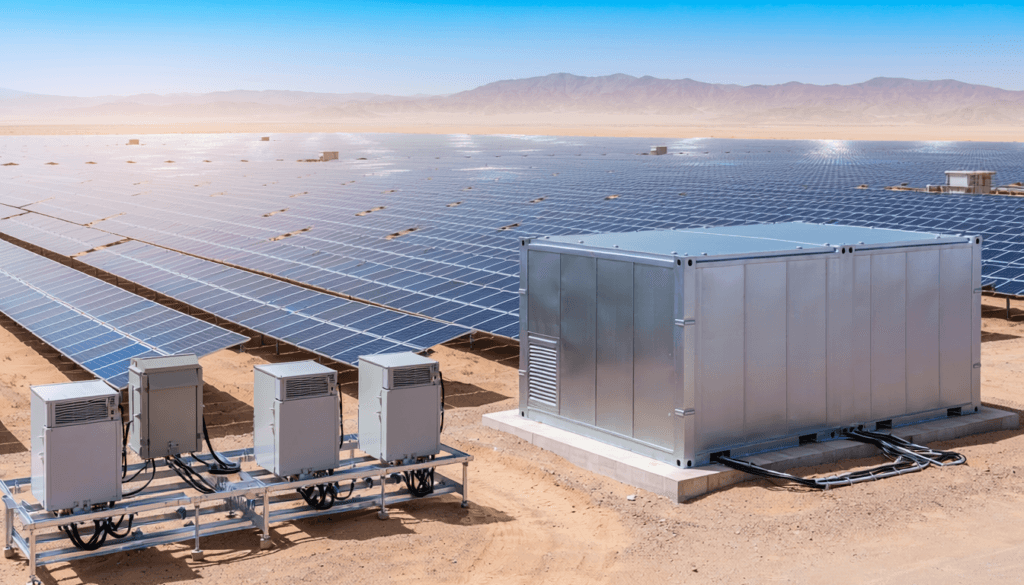
String inverters convert DC electricity from a defined set of panels — a string or a small group of strings — to AC at the inverter level. Each unit handles a fraction of the total array capacity, typically between 15 kW and 100 kW depending on the model. They are generally installed on mounting structures or walls near the array, distributed across the site rather than concentrated in a single technical room.
The defining operational characteristic of string inverter architecture is granularity: if one inverter fails, the production loss is limited to the strings connected to that unit — a fraction of total array capacity. The rest of the installation continues operating normally.
Central inverters aggregate DC production from a much larger section of the array — typically 500 kW to several MW per unit — and convert it to AC at a single point. They are installed in a dedicated technical room or containerized enclosure, physically separated from the array. Fewer units handle the same total capacity, which simplifies the AC collection network and reduces the number of individual maintenance points.
The defining operational characteristic of central inverter architecture is concentration: when a central inverter fails, the production loss is large — an entire block of capacity goes offline simultaneously. The fault is easy to localize, but the production impact is immediately significant and the resolution timeline depends entirely on spare parts availability and technical support access.
Neither architecture is universally superior. The choice depends on a set of site-specific factors that are frequently underweighted in the design process — and that the MENA industrial operating environment makes more consequential than in moderate-climate markets.
How the MENA Environment Impacts String vs Central Inverters
The theoretical comparison between string and central inverter architectures is well-documented in the industry literature. What is less documented — and more relevant to anyone operating or planning an installation in Morocco, Saudi Arabia, Egypt, or across Africa’s industrial C&I market — is how the specific characteristics of the MENA operating environment shift the balance between the two architectures.
The thermal profile — and where the heat goes
The inverter room thermal problem documented in earlier analysis on this blog — ambient temperatures reaching 50°C to 55°C in Morocco’s industrial sites during summer months, triggering thermal derating of 6% to 12% without generating a single monitoring alert — is primarily a central inverter problem.
Central inverters, concentrated in a single technical room, generate significant waste heat that accumulates in an enclosed space. If the ventilation system is undersized, infrequently maintained, or simply not designed for the actual peak summer ambient temperature of the location, the inverter room becomes a thermal trap — and every central inverter in that room derated simultaneously.
String inverters distributed across the array face a different thermal challenge. They are exposed directly to outdoor ambient temperatures and solar irradiance — which can drive their operating temperatures above their rated range during peak summer hours. But the derating, when it occurs, is distributed rather than concentrated. No single failure point derates the entire installation simultaneously.
The practical implication: in MENA industrial environments where summer ambient temperatures routinely exceed 40°C, string inverter architecture eliminates the inverter room as a single point of thermal failure — but introduces distributed thermal stress across dozens of individual units that must each be managed within their own operating envelope. Central inverter architecture concentrates the thermal management challenge in one controllable location — but makes the quality of that thermal management critical to the performance of the entire installation.
An inverter architecture that produces 3% more annual derating losses than the alternative — through inadequate thermal management — costs approximately 5,400 USD per MWp per year in unrealized production. Over 25 years, that represents 135,000 USD per MWp in preventable losses from a decision that was made in a procurement meeting, without a site-specific thermal analysis, in less time than it takes to read this article.
The soiling factor — an underappreciated risk for string inverters
String inverters installed outdoors — mounted on array structures or facility walls — are directly exposed to the dust and particulate environment of the installation site. Their ventilation openings accumulate soiling over time, progressively restricting airflow and degrading the thermal management performance that keeps the unit within its operating temperature range.
On heavy industrial sites in MENA — where particulate concentrations are high and cleaning of inverter ventilation openings is rarely included in standard O&M protocols — this is a real and documented degradation pathway. An outdoor string inverter with progressively blocked ventilation openings effectively becomes a self-heating unit that reaches its thermal derating threshold faster and more frequently than its specification assumes.
A practical preventive protocol for outdoor string inverter ventilation in MENA industrial environments includes three steps: quarterly inspection of all ventilation openings using a flashlight and a compressed air source, cleaning of inlet filters or grilles at each O&M visit using a soft brush or low-pressure compressed air, and a monthly thermal check of inverter housing temperature during peak production hours — flagging any unit that runs significantly hotter than its neighbors under the same irradiance conditions. This protocol costs less than 30 minutes per inverter per quarter on a typical installation — and prevents the progressive thermal performance degradation that unmanaged ventilation soiling consistently produces.
The protection scheme complexity — a factor that matters in practice
The choice of inverter architecture directly affects the complexity of the DC protection scheme — and the behavior of that scheme during earth fault events.
String inverter architecture distributes the DC source across many smaller units, each with its own DC disconnect and string fuse protection. The fault current from any individual string is limited by the small number of parallel strings contributing to that fault — which affects the sizing and coordination of DC protection devices across the installation.
Central inverter architecture concentrates DC collection, which means higher potential fault currents at the inverter DC input and different protection coordination requirements. The interaction between the DC combiner network, the central inverter’s internal protection, and the medium-voltage protection scheme — including the residual voltage function documented in detail in earlier articles on this blog — is more complex with central architecture and requires careful coordination study to avoid both nuisance tripping and genuine fault exposure.
This is not a reason to avoid central inverters. It is a reason to ensure that the protection coordination study for any MENA industrial installation specifies which inverter architecture was assumed — and that any change to that architecture during procurement is reviewed for its protection implications.
The monitoring granularity question
Modern string inverters provide monitoring at the string level — individual string current and voltage data that, when properly configured, gives the operational team visibility into performance at a granularity that was historically only available through physical inspection.
This connects directly to the string loss detection challenge documented earlier on this blog: string losses exceeding 15% of expected output, invisible to central monitoring systems, found only through physical inspection with a calibrated clamp meter.
A string inverter monitoring system properly configured at the string level — with baseline-corrected current data for each string — can detect this type of underperformance before it compounds into a significant financial loss. To put this in financial terms: catching and correcting a 15% string deviation within the first month rather than after 12 months of silent accumulation recovers approximately 10,800 USD per MWp in production that would otherwise have been lost. That is the financial value of string-level monitoring granularity — quantified, not assumed.
The caveat: the monitoring advantage of string inverters is only realized if the monitoring system is properly configured, the baselines are established and maintained, and the operational team is trained to interpret string-level data rather than simply watching total production. A string inverter system with monitoring configured at the inverter level rather than the string level provides the same aggregate visibility as a central inverter — and loses the granularity advantage entirely.
The Maintenance Reality — What Changes the Total Cost of Ownership
The maintenance comparison between string and central inverter architecture is where the theoretical advantages and disadvantages become financial realities.
String inverter maintenance characteristics:
On a typical C&I industrial installation in MENA, string inverter architecture means managing between 20 and 100 individual inverter units, depending on installation size and unit capacity. Each unit requires periodic inspection, firmware updates, connection checks, and ventilation cleaning. The total number of maintenance touchpoints is high — but each intervention is low-impact, low-risk, and executable by a technician with standard skills and tools.
When a string inverter fails, replacing or repairing it typically involves a unit that weighs 20 to 50 kg, can be carried by two technicians, and in many cases can be replaced from stock within hours. The production loss during the repair window is limited to the strings that unit served — a fraction of total capacity.
Central inverter maintenance characteristics:
Central inverter architecture means managing a small number of high-power units — typically two to six for a multi-megawatt C&I installation. Each unit is a complex, high-value piece of equipment that requires specialized maintenance skills, manufacturer support for major interventions, and significant spare parts investment to achieve acceptable response times.
When a central inverter fails, the production impact is immediate and large. A single central inverter outage on a typical industrial installation can represent 20% to 50% of total capacity offline for a duration that depends entirely on spare parts availability and technical support access. In MENA markets where manufacturer service centers may be located hundreds of kilometers from the installation site, this duration can extend to days or weeks.
The honest comparison:
| Maintenance Factor | String Inverter Architecture | Central Inverter Architecture |
|---|---|---|
| Number of maintenance touchpoints | High — 20 to 100+ units | Low — 2 to 6 units |
| Skill level required | Standard technician | Specialized — often manufacturer support |
| Single failure production impact | Low — fraction of capacity | High — 20% to 50% of capacity |
| Spare parts strategy | Multiple low-cost units | Few high-cost components |
| Response time to failure | Hours — replaceable from stock | Days to weeks — specialist dependent |
| Ventilation maintenance | Required per unit — often neglected | Concentrated — easier to manage |
| Monitoring granularity | String-level if configured correctly | Inverter-level — aggregate only |
| Annualized maintenance cost estimate | 8,000 to 15,000 USD per MWp per year | 5,000 to 10,000 USD per MWp per year |
| Single outage production loss | 2% to 5% of annual yield per event | 20% to 50% of annual yield per event |
The lower routine cost of central inverter maintenance must be weighed against the higher impact of each failure event — a risk-adjusted comparison that changes significantly depending on spare parts availability and manufacturer support access in the specific MENA location.
The Honest Recommendation — No Universal Answer
Any article that concludes with a definitive recommendation oversimplifies a decision that genuinely depends on project-specific factors. Here is the framework for thinking through the choice rigorously in a MENA industrial context:
Lean toward string inverter architecture when:
- The installation is below 2 MWp — string architecture’s maintenance complexity is more manageable at smaller scale
- The operational team has limited access to manufacturer technical support — string failures are more self-serviceable
- Monitoring granularity is a priority — the team has the capability to use string-level data effectively
- The site has no dedicated technical room and reliable thermal management would be difficult to achieve
- The protection coordination study is complex and adding a large central inverter DC input would increase complexity significantly
For installations in the 2 to 5 MWp range — which represents the majority of C&I industrial solar deployments in MENA — the choice is genuinely ambiguous and should be decided primarily by two site-specific factors: the quality of the technical room thermal management that can realistically be achieved and maintained, and the proximity and response time of manufacturer technical support for central inverter servicing. If both factors are favorable, central architecture is defensible. If either is uncertain, string architecture’s distributed failure mode provides a more forgiving operational profile for a team that may have limited access to specialized support.
Lean toward central inverter architecture when:
- The installation exceeds 5 MWp — the reduced number of maintenance touchpoints becomes a genuine operational advantage at scale
- The technical room thermal management is reliably achievable and maintained — with temperature monitoring installed
- Manufacturer technical support is accessible — service center proximity and spare parts availability have been confirmed
- The O&M team is experienced with high-power industrial equipment and capable of managing higher-impact failure events
The factor that is almost always underweighted:
The quality of the thermal management solution — whether for the inverter room of a central installation or the outdoor mounting of string units — is more important to long-term performance than the architecture choice itself. A central inverter installation with excellent room thermal management will outperform a string inverter installation with blocked ventilation openings. The reverse is equally true.
For engineers and technical directors who want to build a rigorous framework for inverter selection — covering the electrical, thermal, protection, and maintenance dimensions of this decision — Photovoltaic Systems Engineering by Messenger and Abtahi provides one of the most technically complete treatments available of inverter system design and its interaction with array architecture, protection schemes, and long-term operational performance.
The choice between string and central inverter architecture is made once — at the design stage — and lived with for 25 years. In most MENA industrial installations, this choice is made primarily on the basis of cost and procurement convenience, without a rigorous analysis of the thermal management implications, the protection scheme complexity, the maintenance response time reality, or the monitoring granularity that will determine whether the operational team can actually see what the installation is doing.
None of these factors favor one architecture universally. They favor a rigorous, site-specific analysis that most design processes do not perform — and that most O&M teams inherit without having had the opportunity to influence.
The thermal derating that concentrates in an undersized central inverter room during a MENA summer is financially measurable — approximately 5,400 USD per MWp per year for every 3% of additional derating loss. Over 25 years, that compounds to 135,000 USD per MWp in preventable losses from a decision made without adequate site-specific analysis.
The string-level monitoring granularity that a well-configured string inverter system provides — and that can detect the 15% string deviations that central monitoring consistently misses — is worth approximately 10,800 USD per MWp in recovered production from a single early detection event.
The inverter choice deserves the same rigorous, site-specific analysis as the panel selection, the mounting structure design, and the protection coordination study. On most MENA industrial installations, it does not get it.
That gap is where performance is lost before the first panel is ever installed.
Looking for verified data?
The field insights behind this article are fully documented in the MENA Industrial Solar Data Guide. Get access to real project costs, actual KPIs, and genuine O&M benchmarks from a live industrial installation in the MENA region.
👉📘 75 pages of pure field data. Zero simulations.
👉 Get the Guide — $29 USD
Get the Free Preview
The first 8 pages of the MENA Industrial Solar Data Guide — real Performance Ratio data, soiling measurements, and thermal derating figures from an industrial installation— No spam, just real data.
Disclosure: This article contains affiliate links. If you purchase through these links, I may earn a small commission at no extra cost to you. I only recommend technical resources that I consider genuinely useful for industrial solar professionals working in Africa and the MENA region.
Publié par :
Solar PV MENA Expert