
Published on: Aug 20, 2026.
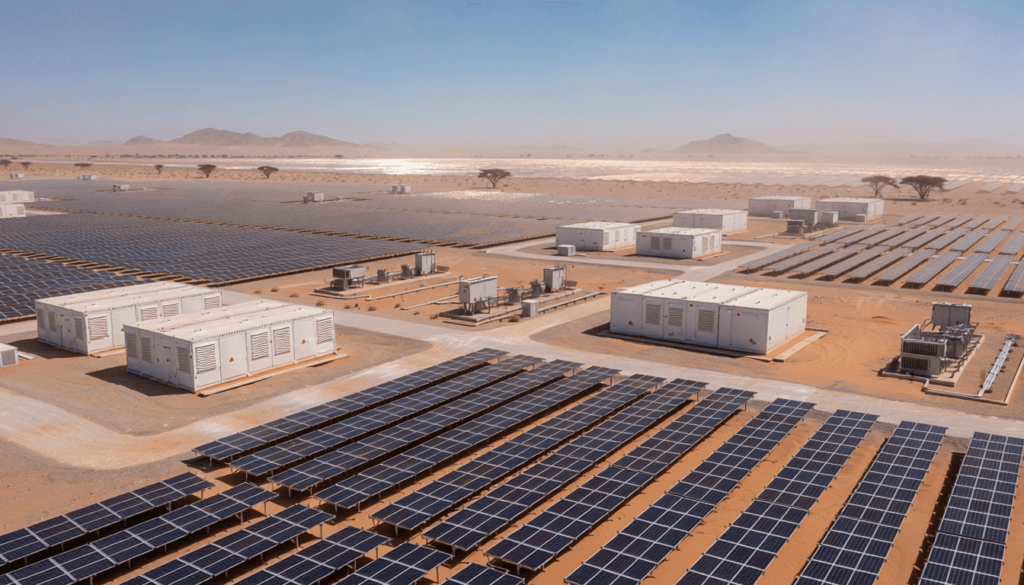
There is a number that changed the conversation about solar + storage in Africa permanently. Seven cents per kilowatt-hour.
That is the price at which a 100 MW solar farm with large battery storage in Mauritius is now delivering reliable electricity — a price that was considered impossible for solar + storage just three years ago.
In Zambia, the Kansanshi copper mine is pairing 100 MW of solar with 40 MWh of storage to achieve full energy autonomy by 2026. In South Africa, the latest IPP procurement round allocated 1.2 GW of battery capacity at tariffs that undercut the coal fleet. In Saudi Arabia, NEOM integrates 2.2 GW of solar PV and 1.65 GW of wind with a 400 MWh battery system to produce 600 tonnes of carbon-free hydrogen daily. In the UAE, a Masdar-led project pairs 5.2 GW of solar with 19 GWh of battery storage — the most ambitious baseload renewable energy project ever announced.
Battery storage has become a condition of bankability for C&I solar projects in Africa. The Africa Solar Outlook 2026 confirms that new storage technologies and price points are pushing back the boundaries of viable solar projects, almost totally eliminating the intermittent aspect of solar while remaining cost-competitive with traditional power generation technologies.
This is genuinely transformative. The intermittency argument that held back C&I solar adoption in markets with unreliable grids is being systematically dismantled by falling battery costs and improving system integration.
But there is something important that is not being discussed in any of the coverage of this transformation — something that every industrial operator considering a solar plus storage investment in MENA or Africa needs to understand before signing a feasibility study and a power purchase agreement.
The same operational gaps that make solar PV installations underperform their financial models will make the battery systems that depend on them underperform their financial models too — for the same reasons, through the same mechanism, with compounding consequences that the standard BESS feasibility model does not capture.
Disclosure: This article contains affiliate links. If you purchase through these links, I may earn a small commission at no extra cost to you. I only recommend technical resources that I consider genuinely useful for industrial solar professionals working in Africa and the MENA region.
What Solar + Storage Actually Changes for C&I Operators
Before examining what can go wrong, it helps to be precise about what solar plus storage actually delivers for a C&I industrial operator in MENA or Africa — because the value proposition is genuinely compelling when the system is properly designed and operated.
Grid independence during outages
For a manufacturing facility, a mining operation, or a data center in a market with unreliable grid supply, the ability to continue operating during grid outages — drawing from a battery system charged by solar — has a direct, measurable financial value: avoided production downtime. In many African industrial markets, grid outages represent 5% to 15% of operating hours annually. The cost of this downtime, in lost production and diesel backup, frequently exceeds the annualized cost of a storage system by a meaningful margin.
Peak tariff management
In markets where electricity tariffs have significant time-of-use components, a solar plus storage system can dramatically reduce peak tariff exposure by storing excess midday solar generation and discharging it during peak tariff windows. This fundamentally changes the financial model for C&I solar: the value is no longer just about the kilowatt-hours generated, but about when they are delivered.
Diesel displacement and operational simplification
Sibanye-Stillwater’s 50 MWh battery deployment saves 18 million liters of diesel annually — an operational and financial outcome that changes how mining operations think about energy. When solar plus storage can displace diesel reliably and cost-effectively, the generator maintenance burden, fuel logistics complexity, and price volatility exposure all decline simultaneously.
Bankability of PPA structures
A solar-only system generates dispatchable power only when the sun shines — which limits the structure of power purchase agreements with industrial offtakers who need consistent supply. A solar plus storage system can commit to dispatchable generation profiles that make PPA structures more straightforward to finance and more attractive to sophisticated industrial energy buyers.
The Solar PV Performance Problem That Carries Directly Into BESS Economics
Here is the connection that every BESS feasibility model in MENA and Africa currently ignores — and that has direct financial consequences for any solar plus storage investment in a high-irradiance, high-dust, high-temperature industrial environment.
A battery storage system charges from a solar PV plant. The energy it stores — and subsequently discharges for peak tariff management, grid backup, or hydrogen production — is limited by what the solar plant actually delivers.
If the solar plant delivers 7% less energy per year than its financial model projected — because soiling runs at 7% rather than the 3% assumed in the feasibility study — the battery system charges 7% less. If the battery system charges 7% less, it discharges 7% less. If it discharges 7% less, the financial return on the battery investment is 7% below projection — from a cause that originated in the solar model and propagated directly into the storage economics without generating a single alert.
| Solar PV Performance Gap | Impact on BESS Charging | Annual Economic Impact per MWh | Financial Impact over 10-year BESS Lifetime |
|---|---|---|---|
| PR 84% projected vs 77% actual | 7% less energy stored annually | 5,040 to 12,600 USD per MWh | 50,400 to 126,000 USD per MWh |
| Soiling 7% vs 3% projected | 4% less charging energy every year | 2,880 to 7,200 USD per MWh | 28,800 to 72,000 USD per MWh |
| Thermal derating 9% in summer | Peak charging reduced during highest-irradiance hours | 3,240 to 8,100 USD per MWh | 32,400 to 81,000 USD per MWh |
| P90 vs P50 solar yield | 5% to 10% below base case in adverse years | Variable — scenario dependent | Material impact on project IRR |
Financial impact calculated based on a stored electricity value of 0.08 to 0.20 USD per kWh — the realistic range for C&I industrial markets in Africa and MENA.
The third row in this table deserves particular attention: inverter thermal derating during peak summer hours — the 6% to 12% output loss documented on industrial installations in MENA that generates no monitoring alert — occurs precisely during the hours when solar irradiance is highest and battery charging is most productive. The summer afternoon hours that a storage system most needs for charging are exactly the hours when thermal derating is most severe.
The BESS-Specific Operational Gaps That Are Rarely Discussed
Beyond the solar input performance problem, battery storage systems deployed in MENA and African industrial environments face their own set of operational challenges that most feasibility studies underestimate.
Thermal degradation of battery cells
Lithium-ion battery cells degrade faster at elevated temperatures. The relationship between operating temperature and calendar aging is well-established: every 10°C increase in average operating temperature approximately halves the calendar life of a lithium-ion cell.
A BESS installed in an enclosure that reaches 40°C to 50°C during MENA summer months — without active thermal management calibrated to actual site conditions — will lose usable capacity faster than the financial model assumes. On a system warranted for 80% capacity retention over 10 years at 25°C average operating temperature, sustained operation at 35°C average can reduce that warranty period to six to seven years.
The financial consequence is direct: a BESS system sized for a 12-year cycle before capacity replacement — at a replacement cost of approximately 150,000 to 250,000 USD per MWh of installed capacity at current market pricing — that requires replacement at year eight due to thermal degradation represents an unbudgeted capital expenditure that was never in the original financial model. On a 5 MWh C&I storage system, this unplanned replacement cost reaches 750,000 to 1,250,000 USD — from a cause that adequate thermal management at commissioning would have largely prevented.
Irregular charging profiles from a soiled solar array
A solar array that accumulates soiling unevenly generates a charging profile for the BESS that is more irregular than a clean array. Persistent irregular profiles — particularly partial charging cycles that repeatedly stop before reaching full state of charge — create electrochemical stress patterns that accelerate cell degradation faster than a uniform charging profile.
This is an O&M interaction that almost no BESS system design study addresses: the cleaning protocol for the solar array affects not just the energy yield but the degradation rate of the battery cells it charges.
Monitoring limitations — the same problem, a different system
The monitoring gap that makes string losses invisible on solar PV installations applies to BESS systems in a different form. Aggregate battery monitoring — total capacity, state of charge, energy in and out — does not detect the gradual degradation of individual battery modules within a rack, or the growing imbalance between cells in a module that precedes accelerated capacity loss.
A BESS that reports 95% state of charge at the system level may have individual modules operating at 80% of their rated capacity — a deviation that is invisible at the aggregate monitoring level and visible only through module-level diagnostic analysis that most C&I BESS O&M contracts do not include.
What a Bankable Solar Plus Storage Feasibility Study Actually Requires
The framework for evaluating solar PV feasibility study assumptions — documented in detail in an earlier analysis on this blog — applies with equal force to solar plus storage feasibility studies, with additional requirements specific to the storage component.
On the solar PV side: a BESS feasibility model built on a solar P50 yield projection with a 3% soiling assumption for an industrial site is not bankable. It is optimistic — with the optimism propagating directly from the solar yield line into the storage dispatch model, the peak tariff savings calculation, and the project IRR.
On the battery side — three additional due diligence questions:
Question 1 — What is the average operating temperature used for battery calendar aging, and is it based on measured site conditions?
Good answer: “We measured peak summer ambient temperature on site and modeled aging at the measured average operating temperature.”
Red flag: “We used the manufacturer’s standard operating specification of 25°C.”
Question 2 — Has the charging profile irregularity from a soiling-affected solar array been modeled in the battery degradation curve?
Good answer: “Yes — we applied a soiling-corrected charging profile with an irregularity factor based on our site-specific soiling study.”
Red flag: “Battery degradation is modeled independently of the solar charging profile.”
Question 3 — Does the O&M scope include module-level battery diagnostic analysis, and at what frequency?
Good answer: “Yes — quarterly module-level diagnostics are included in the O&M contract from year one, with results tracked against the baseline capacity test at commissioning.”
Red flag: “Battery performance is monitored at the system level through the BMS dashboard.”
For engineers and project developers building the analytical framework needed to evaluate solar plus storage projects with genuine rigor — Solar Energy Engineering: Processes and Systems by Soteris Kalogirou provides one of the most comprehensive technical foundations available for system-level analysis of solar PV and its integration with storage and load management.
The Projects That Show What Getting This Right Looks Like
The mining sector in Africa is leading the way in operationally rigorous solar plus storage deployment — and for reasons that are directly instructive for other C&I industrial operators.
Mining companies bring to solar plus storage projects a set of capabilities that manufacturing facilities and commercial operators often lack: experienced asset management teams, strong preventive maintenance cultures, and a willingness to invest in monitoring and diagnostics that go beyond the minimum specified in a contractor’s O&M contract.
The Kansanshi copper project in Zambia pairs 100 MW of solar with 40 MWh of storage for full energy autonomy. Sibanye-Stillwater’s deployment saves 18 million liters of diesel annually. These outcomes are real — and they are achieved by organizations that apply the same operational discipline to their solar plus storage assets that they apply to their processing equipment.
What distinguishes this approach is not the technology. It is the operational discipline applied from day one. Mining companies specify module-level battery diagnostics in their O&M contracts before commissioning. They include inverter room temperature logging in their daily operational checklists. They validate soiling assumptions against site-specific measurements before finalizing the energy yield model. And when monitoring data shows a deviation from expected performance, they investigate the cause rather than waiting for a dashboard alert that may never come.
This is the operational template that any C&I industrial operator — manufacturing, agri-processing, data centers — can apply to solar plus storage projects. It requires no specialized technology. It requires the discipline to ask the right questions before signing and the commitment to maintain the right measurement and inspection protocols after commissioning.
Solar plus storage is genuinely bankable in Africa and MENA in 2026. The technology works. The economics are compelling. The projects are being built, commissioned, and delivering results that were considered impossible three years ago.
The operational challenge is not the technology — it is the assumption gap that persists between feasibility modeling and real-world performance. A solar plus storage feasibility model that accepts a 3% soiling assumption for a heavy industrial site, omits inverter thermal derating, uses P50 yield without a P90 sensitivity case, and models battery degradation at standard temperature conditions is not describing the system that will be commissioned and operated. It is describing an optimistic version of that system.
On a typical C&I solar plus storage project in MENA or Africa — combining a solar soiling gap, inverter thermal derating losses, and accelerated battery degradation from inadequate thermal management — the total gap between modeled and actual financial performance over a 20-year project lifetime reaches hundreds of thousands of dollars per MWp of solar and per MWh of storage. Not from technology failure. Not from market risk. From assumption gaps that were predictable at the feasibility stage and preventable with site-specific validation.
The solar performance gaps documented across industrial installations in MENA — soiling above model assumptions, thermal derating invisible to monitoring, string losses undetected by dashboards — do not disappear when a battery system is added to the project. They propagate into the storage economics with the same mechanical certainty as they propagate into the solar energy yield.
The seven cents per kilowatt-hour achieved in Mauritius is a real outcome. So is the performance gap that develops when the feasibility assumptions meet the operational reality. The difference between these two outcomes is not technology. It is the quality of the analysis before commissioning and the discipline of the supervision after it.
Looking for verified data?
The field insights behind this article are fully documented in the MENA Industrial Solar Data Guide. Get access to real project costs, actual KPIs, and genuine O&M benchmarks from a live industrial installation in the MENA region.
👉📘 75 pages of pure field data. Zero simulations.
👉 Get the Guide — $29 USD
Get the Free Preview
The first 8 pages of the MENA Industrial Solar Data Guide — real Performance Ratio data, soiling measurements, and thermal derating figures from an industrial installation— No spam, just real data.
Disclosure: This article contains affiliate links. If you purchase through these links, I may earn a small commission at no extra cost to you. I only recommend technical resources that I consider genuinely useful for industrial solar professionals working in Africa and the MENA region.
Publié par :
Solar PV MENA Expert