
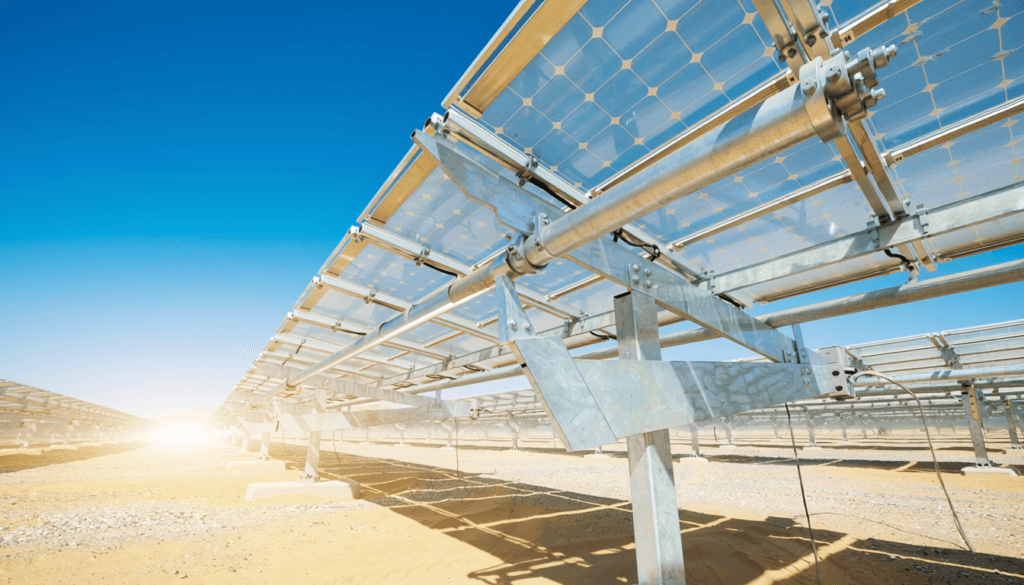
Every solar equipment presentation in MENA right now includes the same slide about bifacial solar panels.
A bifacial panel diagram. An arrow pointing to the back surface. A yield gain figure somewhere between 5% and 30% additional production from reflected light captured on the rear side of the module. A cost comparison showing that the bifacial premium over monofacial has almost disappeared as manufacturing volumes scaled. A conclusion that bifacial is now the obvious choice for any serious solar project in a high-irradiance environment.
The presentation is not wrong. Bifacial technology is genuinely more capable than its monofacial predecessor under the right conditions. The manufacturing cost reduction is real. The deployment numbers confirm that the industry has made its choice — bifacial module technology is capturing a growing share in high-albedo desert environments across the Middle East and Africa.
What the presentation almost never shows is the performance data from real industrial installations operating in the actual conditions of the MENA region — not the optimized test conditions of a manufacturer’s demonstration project, but the dusty, hot, operationally demanding reality of a cement plant, a mining operation, or an industrial zone where panels accumulate soiling within days of cleaning and where rear-side albedo assumptions were calibrated against clean ground surfaces that do not exist.
This article provides the missing presentation.
Disclosure: This article contains affiliate links. If you purchase through these links, I may earn a small commission at no extra cost to you. I only recommend technical resources that I consider genuinely useful for industrial solar professionals working in Africa and the MENA region.
What Bifacial Technology Actually Promises — And Why the Promise Is Conditional
The fundamental principle of bifacial solar technology is straightforward. A conventional monofacial panel captures direct and diffuse irradiance on its front surface only. A bifacial panel captures irradiance on both surfaces — the front receiving direct sunlight, the rear receiving light reflected from the ground surface beneath the array.
The additional energy generated by the rear side — expressed as a bifacial gain percentage — depends entirely on three factors: the reflectivity of the ground surface (albedo), the mounting height and tilt angle of the array, and the transparency of the module frame and backsheet that allows reflected light to reach the rear cells.
Under the conditions that produce the highest bifacial gains — white or light-colored ground surfaces, elevated single-axis tracker mounting, clean panels, and stable irradiance — gains of 10% to 20% above equivalent monofacial production are achievable and have been documented in peer-reviewed field studies.
These are also conditions that describe a minority of real industrial C&I solar installations in MENA and Africa.
The Three Conditions That Determine Real Bifacial Gain — And How MENA Industrial Sites Score on Each
Condition 1 — Ground albedo
Albedo is the reflectivity of the surface beneath the solar array, expressed as a percentage of incident light reflected. Fresh snow reflects approximately 80% to 90% of incoming light. A white rooftop membrane reflects 60% to 80%. Standard concrete reflects 25% to 35%. Compacted desert sand reflects 20% to 40% depending on color and moisture content. Dark gravel or asphalt reflects 5% to 15%.
Most bifacial yield models for MENA projects use albedo assumptions of 25% to 35% for desert ground — a reasonable central estimate for clean, light-colored sand. What these models frequently do not account for is the actual ground surface beneath an operating industrial installation — where vehicle traffic, material handling, spilled liquids, and industrial contamination progressively darken the ground surface, reducing actual albedo toward the 10% to 15% range of contaminated industrial surfaces.
The financial consequence of this assumption gap is direct: a bifacial yield model calibrated to 30% albedo on a site that actually delivers 12% albedo overstates annual rear-side production by a factor that, on a large installation, represents meaningful revenue that will never materialize.
Condition 2 — Soiling and its asymmetric effect on bifacial panels
This is the factor most consistently underestimated in bifacial performance projections for MENA industrial sites — and it has a specific characteristic that makes it more damaging for bifacial than for monofacial panels.
Soiling affects both sides of a bifacial panel. The front side accumulates the same dust and particulate contamination as a monofacial panel. The rear side accumulates a different type of contamination — fine particles that settle from below, particularly on installations with horizontal or low-tilt mounting, and industrial fallout from processes operating near the array.
More importantly, rear-side soiling loss is typically not included in standard O&M cleaning protocols — because it requires either tilting the panels to access the rear surface or using specialized cleaning equipment designed for bifacial arrays. On installations where cleaning is performed by manual labor with conventional cleaning tools, rear-side cleaning is often not performed at all, or performed infrequently enough that the rear surface accumulates a sustained soiling layer that significantly reduces the albedo capture the bifacial gain calculation assumed.
Adding a dedicated rear-surface cleaning protocol to an existing O&M program on a heavy industrial site typically increases cleaning costs by 20% to 40% — since accessing and cleaning the rear surface requires either specialized equipment or additional labor time per cleaning cycle. On an installation where front-surface cleaning already costs 15,000 to 40,000 USD per year per MWp, rear-surface cleaning adds approximately 3,000 to 16,000 USD per year per MWp. This additional O&M cost must be netted against the projected bifacial gain to determine whether the net financial benefit of bifacial technology is positive — a calculation that most bifacial feasibility studies do not perform explicitly.
On a heavy industrial site in Morocco, where cleaning the front surface alone requires three cycles per month to maintain acceptable Performance Ratio levels, adding rear-surface cleaning to the O&M protocol without increasing cleaning resources effectively means the rear-side gain is partially offset by rear-side soiling loss — a dynamic that no manufacturer’s yield projection model includes.
Condition 3 — Mounting configuration and ground clearance
Bifacial gain increases with ground clearance — the distance between the bottom of the panel and the ground surface. Taller mounting structures allow more reflected light to reach the rear surface from a wider angle. They also increase the structural cost of the installation, require more robust wind load calculations, and may conflict with the low-profile mounting designs typically used in rooftop C&I applications.
Most C&I industrial installations in MENA are ground-mounted at standard heights of 0.5 to 1.5 meters above ground level — not the 2 to 3 meter heights that produce the highest bifacial gains in research conditions. The actual rear-side gain at 1 meter ground clearance on a fixed-tilt installation is typically 30% to 50% lower than the gain at 2.5 meters — a reduction that significantly narrows the performance advantage over equivalent monofacial technology.
What the Real Performance Data Shows — Bifacial vs Monofacial in MENA Industrial Conditions
The honest performance picture for bifacial panels in MENA industrial C&I conditions — based on available field data from comparable operating environments — looks significantly different from manufacturer projections:
| Performance Factor | Manufacturer Projection | Real Industrial MENA | Annual Financial Impact |
|---|---|---|---|
| Bifacial gain — optimal conditions | 10% to 20% above monofacial | Reference — rarely achieved on industrial sites | Reference |
| Bifacial gain — standard C&I ground mount | 5% to 10% above monofacial | 2% to 6% realistic | Gap of 10,800 to 14,400 USD/year on 360,000 USD system |
| Rear-side soiling — no dedicated cleaning | Not modeled | Reduces rear gain by 20% to 40% | 2,880 to 7,200 USD/year unaccounted |
| Albedo assumption vs industrial reality | 25% to 35% assumed | 10% to 20% actual | Rear gain overstated by 30% to 50% |
| Net advantage over monofacial — heavy industrial | 10% to 20% marketed | 2% to 8% realistic | Up to 43,200 USD/year projected but not delivered |
Every column in this table represents a real, measurable, and predictable gap — not exceptional circumstances, but the standard operating reality of a heavy industrial site in MENA where ground contamination, soiling, and standard mounting heights combine to reduce bifacial performance well below what the manufacturer presentation suggested.
The Financial Implications of Overestimating Bifacial Gain
On an industrial solar installation generating 360,000 USD per year in energy savings, a bifacial gain projection of 12% that actually delivers 4% in real industrial conditions represents an annual revenue gap of approximately 28,800 USD — energy that was counted in the financial model but will not be generated.
Over a 25-year project lifetime, this gap compounds to approximately 720,000 USD in projected savings that will not materialize — from a performance assumption that was accepted without validation against the specific conditions of the installation.
This does not mean bifacial panels are the wrong choice for industrial MENA sites. It means the financial model should use a conservative, site-validated bifacial gain assumption — not the headline figure from a manufacturer’s datasheet or a demonstration project in optimal conditions.
A conservative bifacial gain assumption of 3% to 6% for a heavy industrial site in MENA — combined with a dedicated rear-surface cleaning protocol and an albedo measurement program — produces a yield projection that is defensible, realistic, and unlikely to disappoint.
What Bifacial Technology Does Well — The Honest Case for Deployment
Despite the performance caveats above, there are genuine and important reasons why bifacial technology is the right choice for many MENA solar projects — including C&I industrial installations.
The cost premium has largely disappeared
At current market pricing, the incremental cost of bifacial over equivalent monofacial capacity is small enough that even a conservative 3% to 5% rear-side gain typically justifies the choice on financial grounds over a 25-year lifetime.
The structural quality of bifacial modules is generally higher
The glass-glass construction used in most bifacial panels provides better protection against potential-induced degradation, moisture ingress, and mechanical stress than conventional backsheet designs — benefits that extend module life in harsh MENA operating environments independent of any bifacial gain consideration.
On rooftop installations with high-albedo surfaces, the gain is real and significant
A C&I rooftop installation on a white membrane roof with 65% albedo — typical of modern industrial buildings in Morocco or Saudi Arabia — can realistically deliver a bifacial gain of 8% to 12% above equivalent monofacial production. On a system generating 360,000 USD per year, that represents 28,800 to 43,200 USD in additional annual energy value — a figure that clearly justifies both the bifacial module choice and the investment in rear-surface cleaning. This is the scenario where bifacial technology delivers on its promise. It is also not the scenario that describes most ground-mounted C&I installations on contaminated industrial sites.
On tracker-mounted utility-scale installations, the case is compelling
Single-axis trackers at optimal ground clearance with clean, light-colored ground surfaces — the conditions typical of large desert solar plants in Saudi Arabia, the UAE, and Morocco’s southern provinces — can achieve bifacial gains of 10% to 20% that are meaningful at gigawatt scale.
The problem is not bifacial technology itself. It is the uncritical application of optimal-condition performance projections to non-optimal installation environments — and the absence of site-specific albedo measurement and rear-side soiling assessment from most C&I feasibility studies.
For engineers and project developers who want to build a rigorous technical understanding of bifacial module performance — including the physical models for rear-side irradiance calculation, albedo sensitivity analysis, and soiling correction for bifacial systems — Photovoltaic Systems Engineering by Messenger and Abtahi provides the foundational treatment needed to evaluate bifacial performance claims with the same rigor applied to any other system-level loss factor.
The Five Questions to Ask Before Accepting a Bifacial Yield Projection
Before accepting any bifacial performance claim in a solar feasibility study for a MENA industrial site, five questions should have clear, documented answers — with an indication of what a credible response looks like versus a response that should prompt deeper investigation:
1. What albedo value was used, and was it measured on this specific site?
Credible answer: “We conducted a ground albedo measurement on this specific site over 30 days and measured 18% average albedo — which we applied directly to the rear-side yield model.”
Red flag: “We used 25% — the standard assumption for desert environments.” A regional default applied without site measurement on an industrial site is not a conservative assumption. It is an optimistic one.
2. Has rear-side soiling been modeled as an explicit loss factor?
Credible answer: “Yes — we applied a 25% rear-side soiling correction based on our O&M protocol that includes rear-surface cleaning every two months, budgeted at X USD per year.”
Red flag: “Soiling is already included in the standard loss model.” Standard soiling loss models cover front-surface soiling only. Rear-side soiling is a separate loss that requires a separate assumption.
3. What is the mounting height, and has the bifacial gain been calculated at actual ground clearance rather than optimal conditions?
Credible answer: “The installation is fixed-tilt at 1.2 meters ground clearance. We applied a bifacial gain of 4% based on the validated irradiance model at this height and the measured albedo.”
Red flag: “We used the manufacturer’s bifacial gain table.” Manufacturer bifacial gain tables are typically calibrated to conditions — ground clearance, albedo, tracker type — that may not match the installation.
4. Does the O&M budget include rear-surface cleaning, and at what frequency?
Credible answer: “Yes — rear-surface cleaning is scheduled quarterly at an incremental cost of X USD per year, included in the O&M budget.”
Red flag: “The bifacial gain is included in the yield model, and the O&M budget is based on standard cleaning protocols.” A bifacial yield projection without a rear-surface cleaning budget is internally inconsistent — the gain assumes a clean rear surface that the O&M program does not maintain.
5. What is the sensitivity of the project IRR to a bifacial gain reduction from projected to conservative?
Credible answer: “At a conservative 4% bifacial gain rather than our projected 10%, the IRR declines from X% to Y% — still above our hurdle rate.”
Red flag: “The project economics are robust across a range of scenarios.” A general statement of robustness is not a sensitivity analysis. If the project IRR falls below the hurdle rate when bifacial gain is reduced from projection to conservative, the project’s financial resilience depends on a performance assumption that may not be realistic for this site.
Bifacial solar panels are a genuine technological advancement — more capable, more durable, and in most market contexts, the right default choice for new industrial solar installations across MENA and Africa.
They are not a performance guarantee. The rear-side gain that manufacturers project and that feasibility models assume is conditional on ground albedo, mounting height, rear-surface cleanliness, and installation geometry — conditions that vary significantly between an optimal demonstration project and a real industrial site where the ground is contaminated, the mounting is standard height, and rear-surface cleaning is not in the O&M schedule.
On a heavy industrial installation generating 360,000 USD per year, the difference between a 12% bifacial gain projection and a 4% operational reality represents 28,800 USD per year — 720,000 USD over a 25-year lifetime — from a performance assumption that was never validated against the specific conditions of the site.
The bifacial gain assumption joins the list of solar PV feasibility study inputs that deserve systematic scrutiny before any financial commitment — alongside soiling loss, inverter thermal derating, P90 scenarios, and O&M budgets. The pattern is consistent: assumptions calibrated to optimal or average conditions, applied without validation to specific industrial sites, producing yield projections that look credible until the installation is commissioned and the real performance data starts arriving. The framework for questioning these assumptions rigorously — before signing, not after commissioning — is documented in detail in an earlier analysis on this blog.
That gap is not inevitable. It is preventable — with site-specific albedo measurement, honest rear-side soiling modeling, and a rear-surface cleaning protocol that is actually budgeted and executed.
The technology is ready. The question is whether the feasibility modeling is honest enough to justify the investment with realistic assumptions — rather than the optimistic ones that make the financial model look better than the site will perform.
Looking for verified data?
The field insights behind this article are fully documented in the MENA Industrial Solar Data Guide. Get access to real project costs, actual KPIs, and genuine O&M benchmarks from a live industrial installation in the MENA region.
👉📘 75 pages of pure field data. Zero simulations.
👉 Get the Guide — $29 USD
Get the Free Preview
The first 8 pages of the MENA Industrial Solar Data Guide — real Performance Ratio data, soiling measurements, and thermal derating figures from an industrial installation— No spam, just real data.
Disclosure: This article contains affiliate links. If you purchase through these links, I may earn a small commission at no extra cost to you. I only recommend technical resources that I consider genuinely useful for industrial solar professionals working in Africa and the MENA region.
Publié par :
Solar PV MENA Expert