
Published on: July 11, 2026.
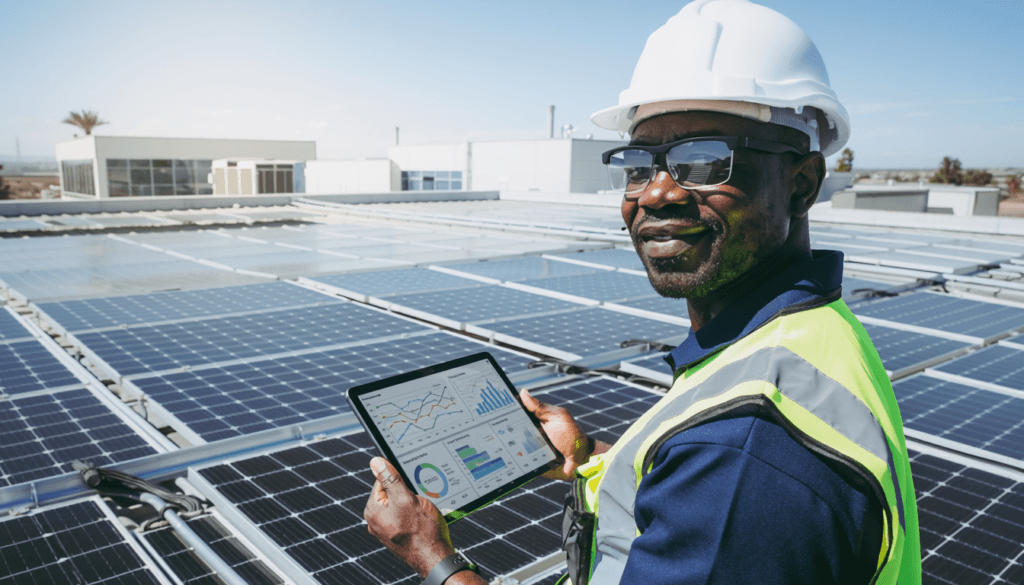
The C&I solar boom in Africa is officially underway, shifting from a future promise into a massive, unmapped economic reality. While headlines focus on large-scale utility projects, a silent revolution is taking place directly on the rooftops of factories, mines, and commercial hubs across the continent.
There is a number that changes how you think about solar energy in Africa.
Not the gigawatts announced by governments. Not the investment commitments from development banks. Not the headline figures from international climate summits.
The number is this: Africa imported 18.2 GW of solar panels in 2025 — but official databases only tracked 4.5 GW of installations.
The gap between those two figures — 13.7 GW of solar panels shipped to Africa that never appeared in any official statistic — is where the real story of African solar is happening. Thousands of commercial and industrial installations, deployed privately, financed by businesses, built on factory roofs, at mining sites, in industrial parks, and at data centers across the continent. A C&I solar boom that is growing at 54% per year and is, by almost every credible estimate, significantly larger than anyone is officially measuring.
At an average system cost of 0.50 USD per watt for C&I installations in Africa, that 13.7 GW gap represents an estimated 6.85 billion USD in privately financed solar assets that are largely operating without standardized supervision frameworks — and whose actual performance is almost entirely unknown.
Around 85% of newly installed solar capacity in Africa is now in the commercial and industrial sector. This is not a footnote. It is the defining characteristic of how Africa’s energy transition is actually unfolding — not through government-led megaprojects, but through thousands of privately financed business decisions made by companies that can no longer afford to depend on unreliable grid power or expensive diesel generation.
The economics are compelling. System costs now sit between 0.08 and 0.20 USD per kWh, compared to approximately 0.38 USD per kWh for diesel. For a manufacturing plant, a mining operation, or a data center in Nigeria, Kenya, or Côte d’Ivoire, that differential is not an environmental argument — it is a straightforward business case.
What is not being discussed — in any of the market reports, investment decks, or conference presentations that celebrate this boom — is what happens after the installation is commissioned.
Disclosure: This article contains affiliate links. If you purchase through these links, I may earn a small commission at no extra cost to you. I only recommend technical resources that I consider genuinely useful for industrial solar professionals working in Africa and the MENA region.
The C&I Solar Boom Nobody Is Supervising
Here is the operational reality that the growth figures do not capture.
The same characteristics that make Africa’s C&I solar market move fast — private financing, decentralized deployment, minimal regulatory oversight, rapid installation timelines — also mean that most of these installations are commissioned without a robust operational framework. No systematic cleaning protocol calibrated to the actual soiling behavior of the site. No inverter room thermal management strategy designed for local climate conditions. No supervision approach that goes beyond what a monitoring dashboard shows.
In Morocco, on a real industrial solar installation with documented field data, three cleaning cycles per month proved to be the minimum required to keep soiling from becoming a significant performance drag — and even at that frequency, soiling returned within days. The feasibility study for that installation assumed a soiling loss of 3% to 5% annually. The operational reality was 5% to 8%.
Now consider that the African C&I market is deploying solar across cement plants, mining operations, agricultural processing facilities, and industrial zones — environments where dust, particulate contamination, and proximity to heavy industrial activity create soiling conditions that are at least as demanding as a North African industrial site, and in many cases more so.
The soiling assumption baked into every feasibility study across this market is almost certainly wrong. Not by a rounding error — by a factor that compounds annually across a 25-year project lifetime into a financial gap that is measurable, predictable, and almost entirely preventable.
What Africa’s C&I Market Is Getting Wrong — And Why It Matters at Scale
The African C&I solar market is not making new mistakes. It is making the same mistakes that have been documented on industrial solar installations across the MENA region — at a scale and speed that amplifies their financial consequences.
Mistake 1 — Soiling assumptions calibrated to regional averages, not site realities
Standard feasibility studies across Africa use soiling loss assumptions of 3% to 5% annually — the same generic figures applied across Morocco, Saudi Arabia, and now Nigeria, Kenya, and South Africa, regardless of whether the installation is on a clean office rooftop or next to a cement kiln.
On heavy industrial sites in Africa — where unpaved roads, construction activity, and industrial emissions create particulate environments that are far more aggressive than a residential rooftop — the actual sustained soiling loss is closer to 5% to 8% annually, based on measured field data.
The financial difference between a 3% assumption and a 7% operational reality on a system generating 180,000 USD per MWp per year in energy savings is 7,200 USD per year per MWp — compounding across a 25-year project lifetime into a significant and entirely preventable financial gap.
Consider a 5 MWp C&I installation at a mining operation in Ghana — a market where C&I solar is growing rapidly. At a system cost of 0.14 USD per kWh versus 0.38 USD for diesel, the financial case is compelling. But if soiling losses run at 7% rather than the 3% modeled in the feasibility study, the installation loses approximately 63,000 USD per year in unrealized savings — 1,575,000 USD over a 25-year lifetime — from a single cause that a calibrated cleaning program would largely prevent.
At the scale of Africa’s C&I market — with 3.5 GWp tracked in 2025 alone, and projections suggesting a significant increase in 2026 — the aggregate financial impact of systematic soiling underestimation across this portfolio runs into hundreds of millions of dollars annually.
Mistake 2 — Inverter thermal management designed for datasheets, not African climates
Inverters are rated for operating environments. Those ratings are frequently calibrated to moderate climates — not to the ambient temperatures of sub-Saharan Africa in the dry season, or the coastal humidity of West Africa, or the extreme heat of the Sahel.
When ambient temperature in an inverter room exceeds the derating threshold — typically between 40°C and 45°C depending on the manufacturer — the inverter automatically reduces output to protect its components. This generates no alarm. It appears in no monitoring report. It simply erodes production during peak hours, silently, every day of every summer for the life of the asset.
On a MENA industrial installation with a documented inverter room temperature of 50°C to 55°C during summer months, the observed thermal derating was 6% to 12% of rated output. In parts of West Africa, the Sahel, or East Africa’s arid interior, ambient temperatures routinely meet or exceed these levels. The derating is not a theoretical risk — it is a predictable, calculable operational reality that most African C&I feasibility studies do not model.
Mistake 3 — Monitoring systems that record production without explaining performance
The C&I solar market in Africa is deploying monitoring systems at scale. This is progress. But monitoring records what the meter measures — it does not explain why the meter shows what it shows.
String losses exceeding 15% have been identified on industrial installations through physical inspection — losses that generated no monitoring alerts and were invisible in production data until a systematic on-site measurement program found them. There is no technical reason why the same losses would not occur, and go undetected, on installations across Africa operating under the same monitoring paradigm.
The most expensive performance losses on industrial solar installations are the ones that look like nothing on a dashboard. This is not a statement about Africa specifically — it is a statement about the fundamental limitation of passive monitoring as a substitute for active supervision. It applies equally in Morocco, Saudi Arabia, and Nigeria.
The Companies Getting This Right
Africa’s C&I solar market is not monolithic. There are developers, O&M providers, and asset managers who understand that commissioning an installation is not the same as supervising it — and who are building the operational discipline required to close the gap between projected and actual performance.
Data centers and mining companies are emerging as particularly active and sophisticated C&I solar procurers. Mining companies, in particular, bring strong balance sheets, experienced asset management teams, and a culture of operational rigor that translates well to solar supervision. A copper mining operation in the DRC or a gold mine in Ghana that has managed complex industrial equipment for decades understands what preventive maintenance means — and applies that understanding to its solar assets.
The most disciplined C&I solar operators in Africa share three characteristics that distinguish their operational approach: they size their cleaning programs against measured soiling data rather than generic assumptions, they design their inverter rooms for local climate conditions rather than datasheet ratings, and they treat physical inspection as a scheduled maintenance activity rather than a response to alarms. These are not complex decisions. They are deliberate ones — made before commissioning, not after the first quarterly review shows a performance gap.
These are the installations that will deliver what their financial models promised over a 25-year lifetime. Not because their equipment is better, but because their operational approach is different.
For engineers, O&M managers, and project developers working across Africa’s expanding C&I solar market who want to build a rigorous operational framework — one that translates field performance data into maintenance protocols, financial models, and asset management decisions — Solar Energy Engineering: Processes and Systems by Soteris Kalogirou remains one of the most analytically complete references available. It covers degradation mechanisms, soiling behavior in high-irradiance environments, and system-level performance modeling with the depth needed to interrogate a feasibility study’s assumptions and build an O&M program that actually matches the operating environment.
What the Next Five Years Look Like — If the Operational Gap Is Not Closed
Africa is projected to build between 14.3 GW and significantly more of solar capacity in 2026 and 2027 under medium and high scenarios. The C&I sector will account for the majority of this deployment — privately financed, rapidly installed, and largely outside the oversight frameworks that govern utility-scale projects.
If the operational gap — between what feasibility studies project and what installations actually deliver — remains at current levels across this portfolio, the aggregate financial consequence over the next decade is substantial. Not in any single project, but across thousands of installations simultaneously underperforming their financial models by 5% to 15% annually, without anyone formally identifying the gap or taking corrective action.
This is not a prediction of failure. Africa’s C&I solar market is built on a genuinely compelling economic foundation — the diesel displacement argument is real, the irradiance is exceptional, and the private sector appetite for energy independence is growing. These installations will generate value even at suboptimal performance levels.
The question is not whether the market will grow. It will. The question is whether it will grow with the operational discipline required to deliver on the financial returns that are justifying the investment — or whether it will grow with the same passive monitoring and generic O&M benchmarks that are leaving significant value on the table across the MENA region.
Morocco has been learning these lessons on real installations, with real measured data, over years of operation. The data is available. The protocols exist. The financial case for proactive supervision has been quantified.
Africa’s C&I solar market does not need to learn the same lessons from scratch. It needs to apply them, at speed and at scale, before the operational gap compounds into something significantly more expensive to correct.
The fastest solar growth on earth is happening in Africa’s C&I sector. The economics are real. The market momentum is genuine. The business case for solar over diesel has never been stronger.
What is not growing at the same pace is the operational discipline required to make these installations perform over their full project lifetime — the supervision protocols, the site-specific O&M frameworks, and the honest, data-driven performance benchmarks that determine whether a solar asset delivers what its financial model promised.
If you are commissioning a C&I solar installation in Africa in 2026, start with three questions before the first panel is installed: what is the actual soiling rate on this specific site, not the regional average? What is the maximum ambient temperature in the inverter room in the hottest month of the year? And what is the physical inspection protocol — not the monitoring alert threshold, but the on-site measurement schedule? The answers to those three questions will determine more of your long-term financial outcome than any other decision you make at the design stage.
A 54% annual growth rate in installations is a reason to be optimistic about Africa’s energy future.
It is also a reason to be honest about what happens when thousands of installations are commissioned without a plan for what comes next.
The boom is real. The supervision gap is real. And the cost of ignoring the second while celebrating the first is entirely calculable — and entirely preventable.
Looking for verified data?
The field insights behind this article are fully documented in the MENA Industrial Solar Data Guide. Get access to real project costs, actual KPIs, and genuine O&M benchmarks from a live industrial installation in the MENA region.
👉📘 75 pages of pure field data. Zero simulations.
👉 Get the Guide — $29 USD
Get the Free Preview
The first 8 pages of the MENA Industrial Solar Data Guide — real Performance Ratio data, soiling measurements, and thermal derating figures from an industrial installation— No spam, just real data.
Disclosure: This article contains affiliate links. If you purchase through these links, I may earn a small commission at no extra cost to you. I only recommend technical resources that I consider genuinely useful for industrial solar professionals working in Africa and the MENA region.
Publié par :
Solar PV MENA Expert