
There is a specific moment I remember clearly.
It was August. Mid-morning. The dashboard was green — every string active, no alarms, production numbers that looked acceptable for the time of day. On paper, the plant was running fine.
Something felt off.
I walked to the inverter room. I opened the door. The heat hit me before I could see anything clearly. The thermometer on the wall read 52°C. The inverters were running — no fault codes, no warnings — just quietly, systematically, producing less than they should have been.
That was the day I understood something that no feasibility study had prepared me for: in MENA climates, the inverter room is where performance goes to die in silence.
Disclosure: This article contains affiliate links. If you purchase through these links, I may earn a small commission at no extra cost to you. I only recommend technical resources that I consider genuinely useful for industrial solar professionals working in Africa and the MENA region.
What Thermal Derating Actually Means
Every inverter has a temperature threshold — typically between 40°C and 45°C ambient, depending on the manufacturer. Below that threshold, it operates at full rated power. Above it, the inverter automatically reduces its output to protect its internal components from heat damage.
This is not a malfunction. It is a protection mechanism.
The problem is that this protection mechanism costs you money every single day of summer — and it does so without triggering a single alarm.
To understand the real scale of the problem, consider a realistic derating curve for a typical string inverter: a unit rated at 100% output at 40°C may derate to approximately 88% at 50°C — and further down to around 79% at 55°C. The curve does not decline gradually and evenly. It steepens as temperature rises, meaning the hottest hours of the hottest days carry a disproportionate share of the losses.
This is precisely the kind of system-level behavior that separates engineers who understand their plant from those who simply monitor it. If you want to go deeper on the thermal physics behind this — and on how balance-of-system components behave under real operating conditions — Photovoltaic Systems Engineering by Messenger and Abtahi is one of the few references that treats inverter thermal behavior with the same analytical rigor as panel performance. It is the kind of book that changes how you read a monitoring report.
In Morocco, in Algeria, in Saudi Arabia, in Egypt — anywhere in the MENA region where summer ambient temperatures routinely exceed 40°C — this is not a theoretical risk. It is a daily operational reality that most plant operators are simply not measuring.
The Numbers From the Field
Here is what direct observation on a 2 MWp industrial installation in Morocco shows.
Inverter room ambient temperature in summer sits consistently between 50°C and 55°C. This is not the outdoor temperature. This is the temperature inside the technical room where the inverters operate — a room that absorbs heat from the roof, from the equipment itself, and from ventilation that was never properly designed for the climate it operates in.
Most string and central inverters begin reducing output above 40°C to 45°C. The observed performance loss at 52°C on this specific installation is between 6% and 12%. This figure is not from a simulation. It is the gap between expected output — corrected for irradiation and panel temperature — and actual measured output during peak summer hours.
The financial translation is straightforward. With annual energy savings of approximately 360,000 USD, applying a conservative 8% derating loss across four peak summer months gives:
360,000 USD × 8% × (4 months ÷ 12 months) = 9,600 USD per year in avoidable losses.
Over a 25-year project lifetime, that figure exceeds 240,000 USD — from one single cause that generates no alarm, no fault code, and no alert of any kind on the monitoring dashboard.
That is not rounding error. That is a structural performance gap that was never accounted for at the design stage — and that silently erodes returns every summer for the entire life of the asset.
Why This Never Appears as an Alert
This is the part that surprises most engineers when they first encounter it.
The inverter is functioning. It is doing exactly what it was designed to do — protect itself from overheating by reducing output. From the monitoring system’s perspective, there is no fault. There is no alarm. There is no red indicator on the dashboard.
What you see is simply: lower production.
And lower production in summer has a hundred possible explanations — passing clouds, soiling, a slightly lower irradiation day. The thermal derating signal is buried inside normal operational variability. Without a dedicated temperature sensor in the inverter room feeding into the monitoring system, it is virtually impossible to isolate this loss from the others through data analysis alone.
The issue on this installation was identified through physical inspection — not through data.
That detail matters more than it might seem. The most expensive problems on industrial solar plants are often the ones that look like nothing on a screen. A green dashboard is not a performance guarantee. It is simply confirmation that the system is alive. What it does not tell you is how efficiently that system is actually running.
What You Can Actually Do About It
There is a realistic range of interventions available, and it is important to be honest about what works and what does not.
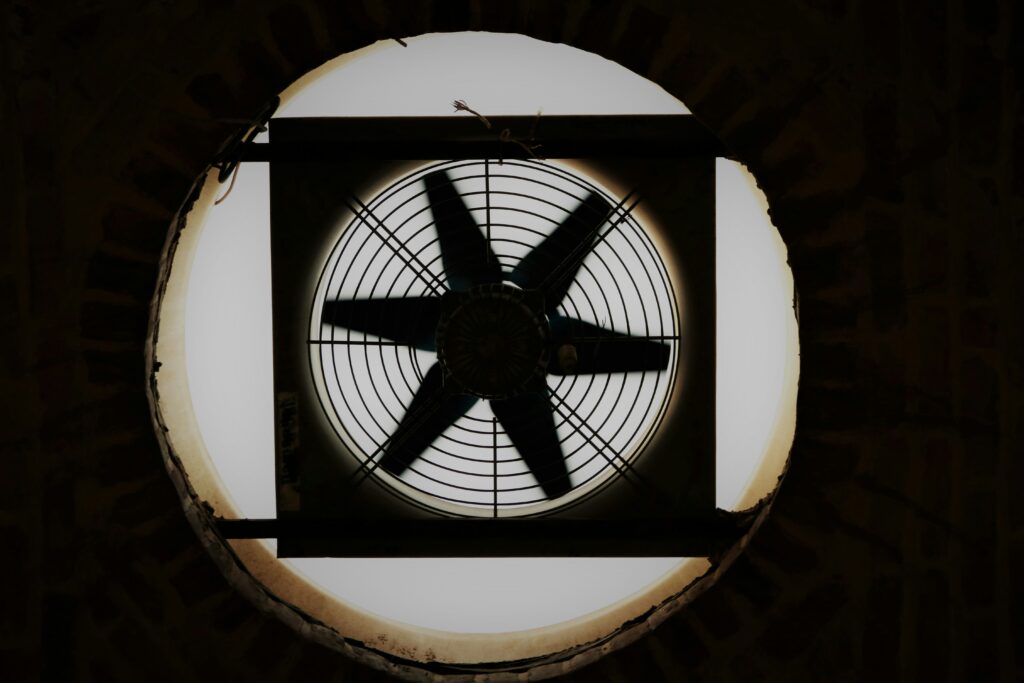
Mechanical ventilation is the most cost-effective first step in most configurations. Forced air extraction from the inverter room, properly sized and positioned, can reduce ambient temperature by 8°C to 15°C. This is not complex engineering. It is a fan, a duct, and a thermal calculation. But it can move the operating environment from 52°C back below the derating threshold during a significant portion of the peak production hours.
A properly sized mechanical ventilation system for a small inverter room typically costs between 800 and 2,500 USD installed. Against 9,600 USD in annual recovered production, the payback period on a well-executed ventilation upgrade can be under four months. Few interventions on an operating solar plant offer that kind of return.
Room orientation and insulation matter enormously — but they are design-stage decisions. The inverter room should not face west and should not have an uninsulated metal roof in direct sun exposure. In practice, many industrial installations are built with cost minimization at every step, and the inverter room ends up in the worst possible thermal configuration as a result. Retrofitting insulation is possible but expensive. Getting it right at the design stage costs almost nothing by comparison.
Ambient temperature monitoring inside the inverter room is not optional if the goal is to understand actual plant performance. A simple temperature logger — or ideally a sensor integrated into the SCADA or monitoring platform — provides the data needed to correlate production losses with thermal events in real time. Without this data, the losses remain invisible and unquantifiable. You cannot manage what you cannot measure.
Oversized air conditioning in poorly sealed rooms is a solution that looks credible on paper and frequently underperforms in practice. The compressor fights against constant heat infiltration, energy consumption increases, maintenance costs accumulate, and the net thermal improvement is often marginal. It is an expensive intervention that addresses the symptom — heat — without addressing the cause — a room that was never designed to manage it. Cooling a thermally compromised room is not a strategy. It is a workaround.
The Gap That Feasibility Studies Never Fill
Most solar feasibility studies for industrial projects in the MENA region model panel temperature losses carefully. The temperature coefficient of monocrystalline panels — typically around -0.35% per degree Celsius above 25°C — is factored into the energy yield calculations as standard practice.
Inverter room thermal losses are almost never modeled with the same rigor.
The assumption, implicit or explicit in most studies, is that the inverters will operate within their rated thermal envelope. In a climate where summer ambient temperatures regularly exceed 40°C and inverter rooms routinely reach 52°C, that assumption is not conservative. It is wrong.
An independent review of a feasibility study for a project exceeding five million euros in Morocco revealed exactly this gap. The inverter thermal derating scenario was not included as a sensitivity case. The P50 yield projection was built on clean irradiation data with standard loss assumptions — soiling underestimated, inverter thermal losses entirely absent from the model.
The gap between projected and actual performance in climates like Morocco is not bad luck. It is not exceptional. It is the predictable consequence of applying standard European modeling assumptions to a North African operating environment — and it is entirely preventable if the right questions are asked before the contract is signed.
Here is a simple benchmark that separates plants that are truly supervised from plants that are simply monitored.
Ask the operator: What was the average ambient temperature in your inverter room last August?
If there is no answer — no data, no log, no measurement — then the real performance of that installation is not fully understood. The dashboard numbers are known. The financial exposure is not.
The inverter room in summer is where the gap between designed performance and real performance lives. It is a hot, unglamorous, operationally underestimated space. And over the life of an industrial solar asset, it is one of the most financially consequential rooms on the entire site.
Over 25 years, the difference between a properly managed inverter room and an ignored one can exceed 240,000 USD on a single 2 MWp installation — silently, without a single alarm, without a single fault code, without a single line in the monitoring report that flags a problem.
The inverter was not broken. It was just hot. And hot costs money — quietly, every single day, for years.
If you have not measured it yet, this summer is a good time to start.
Looking for verified data?
The field insights behind this article are fully documented in the MENA Industrial Solar Data Guide. Get access to real project costs, actual KPIs, and genuine O&M benchmarks from a live industrial installation in the MENA region.
👉📘 75 pages of pure field data. Zero simulations.
👉 Get the Guide — $29 USD
Get the Free Preview
The first 8 pages of the MENA Industrial Solar Data Guide — real Performance Ratio data, soiling measurements, and thermal derating figures from an industrial installation— No spam, just real data.
Disclosure: This article contains affiliate links. If you purchase through these links, I may earn a small commission at no extra cost to you. I only recommend technical resources that I consider genuinely useful for industrial solar professionals working in Africa and the MENA region.
Publié par :
Solar PV MENA Expert