
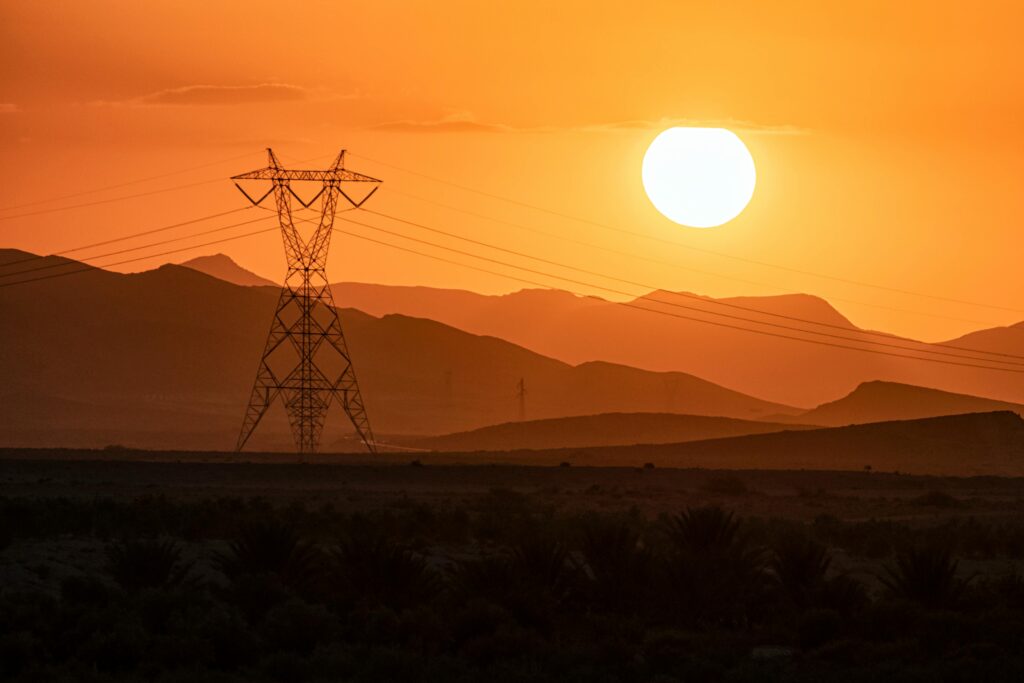
I supervise a solar PV system for a cement plant in Morocco. Every day I see the gap between what a solar project promises on paper and what it actually delivers on a real industrial site.
The failures I am going to describe are not dramatic. There is no explosion, no blackout. The system runs, produces energy, and looks fine on the monitoring dashboard. But somewhere between the feasibility study and year three of operation, the ROI starts quietly drifting south.
I have seen every single one of these mistakes on real projects. Some of them I caught early. Some of them I discovered too late. All of them are avoidable — if you know what to look for before you sign the EPC contract.
Here are the five mistakes that most consistently destroy the financial returns of solar PV projects in Africa and the MENA region.
Disclosure: This article contains affiliate links. If you purchase through these links, I may earn a small commission at no extra cost to you. I only recommend technical resources that I consider genuinely useful for industrial solar professionals working in Africa and the MENA region.
Mistake 1 — Trusting irradiation data without field validation
This is the mistake that starts before a single panel is installed — and it haunts the project for 25 years.
Most project developers pull GHI data from a single satellite source — SolarGIS or PVGIS — and use it directly in their yield model without any validation. The problem is that satellite-derived irradiation data carries an uncertainty margin of 3 to 8%. In some locations, local shading, dust haze, or microclimate effects push that error even higher.
On a project worth 2 million USD, a 5% irradiation overestimate means a 5% revenue shortfall every single year for 25 years. Do the math — that is a serious financial loss hidden behind a clean-looking simulation report.
The professional standard is on-site pyranometer measurement for 6 to 12 months before financial close. If the project timeline does not allow this, cross-reference at least two satellite sources and apply a conservative 5% uncertainty buffer to your P90 production estimate.
Never present a yield model to investors or a bank based on a single unvalidated data source. It is not conservative engineering — it is financial risk dressed up as technical analysis.
Mistake 2 — Ignoring soiling losses in industrial environments
This is the mistake I see most often in the MENA region — and the one that costs the most money over time.
Generic solar yield models apply a soiling loss of 1 to 2% per year. That figure is derived from residential rooftop projects in temperate European climates. It has absolutely nothing to do with the reality of an industrial site in North Africa.
Let me give you a concrete example from direct field experience.
I manage the cleaning schedule for a solar PV system at a cement plant in Morocco. Here is what our real cleaning program looks like on the ground :
We clean every single panel once per week — which means each panel is cleaned approximately three times per month. Even with this intensive cleaning frequency, soiling visible to the naked eye reappears within days of each cleaning cycle in high-production periods near the cement handling and clinker areas.
Read that again slowly. Three cleanings per panel per month — and soiling still comes back within days.
Now compare this to the standard yield model assumption of 1 to 2% annual soiling loss. That assumption was built for a residential rooftop in Germany. Applied to a cement plant in Morocco, it is not just wrong — it is dangerously wrong.
At an industrial facility in the MENA region — cement plants, quarries, phosphate processing sites, steel facilities — real soiling losses without a systematic and intensive cleaning program can reach 15 to 25% of annual production. This is not a marginal adjustment. This is the difference between a project that delivers its promised IRR and one that quietly destroys investor returns for 25 years.
What this means practically for your project :
— Budget for a dedicated cleaning team from day one — not as an afterthought
— Install a soiling ratio sensor and a reference clean panel to measure real soiling rates on your specific site
— Negotiate a soiling-adjusted performance guarantee with your EPC contractor — not a standard one based on European assumptions
— Include real soiling rates in your financial model before presenting to investors or banks
If your feasibility study shows soiling losses below 5% for an industrial site in the MENA region — your consultant has never managed a real industrial solar system in this climate.
For a rigorous technical treatment of soiling mechanisms, degradation, and O&M best practices for industrial solar sites, Operation and Maintenance of Large Solar Power Plants — is the reference I return to most often. It addresses hot and arid climate conditions honestly — unlike most European-focused O&M literature.
Mistake 3 — Sizing for peak demand instead of baseload
I have seen this mistake on multiple projects in Morocco — and it is the most expensive sizing error an industrial operator can make.
A plant manager looks at his utility bill, sees a 4 MW peak demand, and requests a 4 MWp solar system. The logic feels right. The result is a system that regularly produces more electricity than the facility can consume — and in Morocco, as in most MENA markets, that surplus is exported to the grid at near-zero tariffs or simply wasted.
The correct approach is to size your solar system to cover 70 to 80% of your average daytime baseload — not your peak demand. Peak demand events last minutes. Solar production lasts 8 to 10 hours. The financial logic is completely different.
On the 2 MWp project I described in my previous article, we sized specifically to cover 75% of average daytime consumption. The result is a self-consumption ratio close to 100% — nearly every kilowatt-hour produced is immediately consumed by the facility. No waste. Maximum ROI.
If your contractor proposes to size your system based on your peak demand without explaining the self-consumption implications — that is a red flag.
Mistake 4 — Ignoring inverter temperature derating
This is the technical mistake that surprises most investors when they first see the summer performance data.
Inverters lose output power when ambient temperature exceeds their rated operating range — typically above 40 to 45 degrees Celsius. In industrial sites across Morocco and the broader MENA region, inverter room temperatures regularly reach 50 to 60 degrees Celsius during summer months without adequate ventilation.
Many EPC contractors install inverters in unventilated rooms or directly exposed to afternoon sun — then wonder why the system underperforms by 6 to 10% during the hottest months of the year. The yield model looked correct because the designer assumed standard test conditions. The site reality was never accounted for.
The solution is straightforward but must be specified before installation :
— Inverters must face north or be shaded from direct afternoon sun
— Forced ventilation or air conditioning in the inverter room is mandatory in MENA climates
— The manufacturer’s thermal derating curve must be applied in the yield model
— Temperature monitoring must be integrated into the SCADA system from day one
This is not premium engineering. It is basic climate-appropriate design for our region. Any contractor working in Africa or MENA who does not address this proactively is not experienced enough for your project.
Mistake 5 — No performance baseline at commissioning
This is the mistake I find hardest to understand — because it costs nothing to avoid and everything to ignore.
I have visited solar systems that were handed over without a single documented performance ratio measurement at commissioning. The EPC contractor hands over the keys, the monitoring system shows green, and everyone assumes the system is performing correctly.
Six months later, one of the inverter strings has a ground fault reducing output by 8%. A soiling event has reduced production by 12%. A module has developed a hotspot visible only on infrared thermography. Nobody notices — because there is no baseline to compare against.
Let me give you a concrete reference point from real projects I have observed and supervised in Morocco.
Across multiple industrial solar installations in our region, the Performance Ratio we consistently measure and monitor falls between 77% and 84% under normal operating conditions. This is our real-world baseline — not a theoretical number from a simulation tool.
What does this mean in practice ?
A system commissioned without a documented PR baseline has no reference point. If performance drops from 82% to 74% over 18 months — nobody detects it. Nobody investigates. Nobody acts. The investor loses 8% of projected revenue every year while the monitoring dashboard still shows green.
A system commissioned with a documented PR baseline in the 77–84% range immediately flags any deviation. A drop to 74% triggers an investigation within days — not years.
The difference between these two scenarios is one to two days of measurement work at commissioning. That is all.
At commissioning, every industrial solar project must document :
— Performance Ratio under clear sky conditions — real-world target for MENA industrial sites : 77% to 84% — Infrared thermography of all modules — identifies hotspots and delamination from day one — IV curve tracing on a representative sample of strings — confirms panel performance matches datasheet — Inverter efficiency measurement at multiple load points
I document all of these measurements at the start of every operating season on our site. It is not bureaucracy — it is financial protection for a multi-million euro investment.
If your EPC contractor cannot tell you what Performance Ratio to expect from your system at commissioning — and cannot provide a measured baseline on handover day — do not sign the acceptance certificate.
None of these five mistakes are exotic or unpredictable. They are all well-known in the industry. They are all avoidable with proper engineering diligence and operational discipline.
But avoiding them requires someone on the project — either internally or as an independent advisor — who has actually supervised a running industrial solar system in this climate. Not just designed one in an office. Not just modelled one in PVsyst. Actually managed one — including the cleaning crew, the inverter room temperatures, the soiling sensors, and the performance ratio reports.
Morocco and the broader MENA region have some of the best solar conditions in the world. The irradiation is there. The economics are there. The only variable is the quality of the technical and operational decisions made before and during construction.
If you are developing or operating a C&I solar project in Africa or the MENA region and want an independent technical review of your design assumptions, O&M procedures, or performance data — the contact form is open.
More articles coming soon — AI applications for solar O&M, predictive maintenance for industrial PV systems, and a deep dive into performance ratio monitoring.
Looking for verified data?
The field insights behind this article are fully documented in the MENA Industrial Solar Data Guide. Get access to real project costs, actual KPIs, and genuine O&M benchmarks from a live industrial installation in the MENA region.
👉📘 75 pages of pure field data. Zero simulations.
👉 Get the Guide — $29 USD
Get the Free Preview
The first 8 pages of the MENA Industrial Solar Data Guide — real Performance Ratio data, soiling measurements, and thermal derating figures from an industrial installation— No spam, just real data.
Disclosure: This article contains affiliate links. If you purchase through these links, I may earn a small commission at no extra cost to you. I only recommend technical resources that I consider genuinely useful for industrial solar professionals working in Africa and the MENA region.
Publié par :
Solar PV MENA Expert